
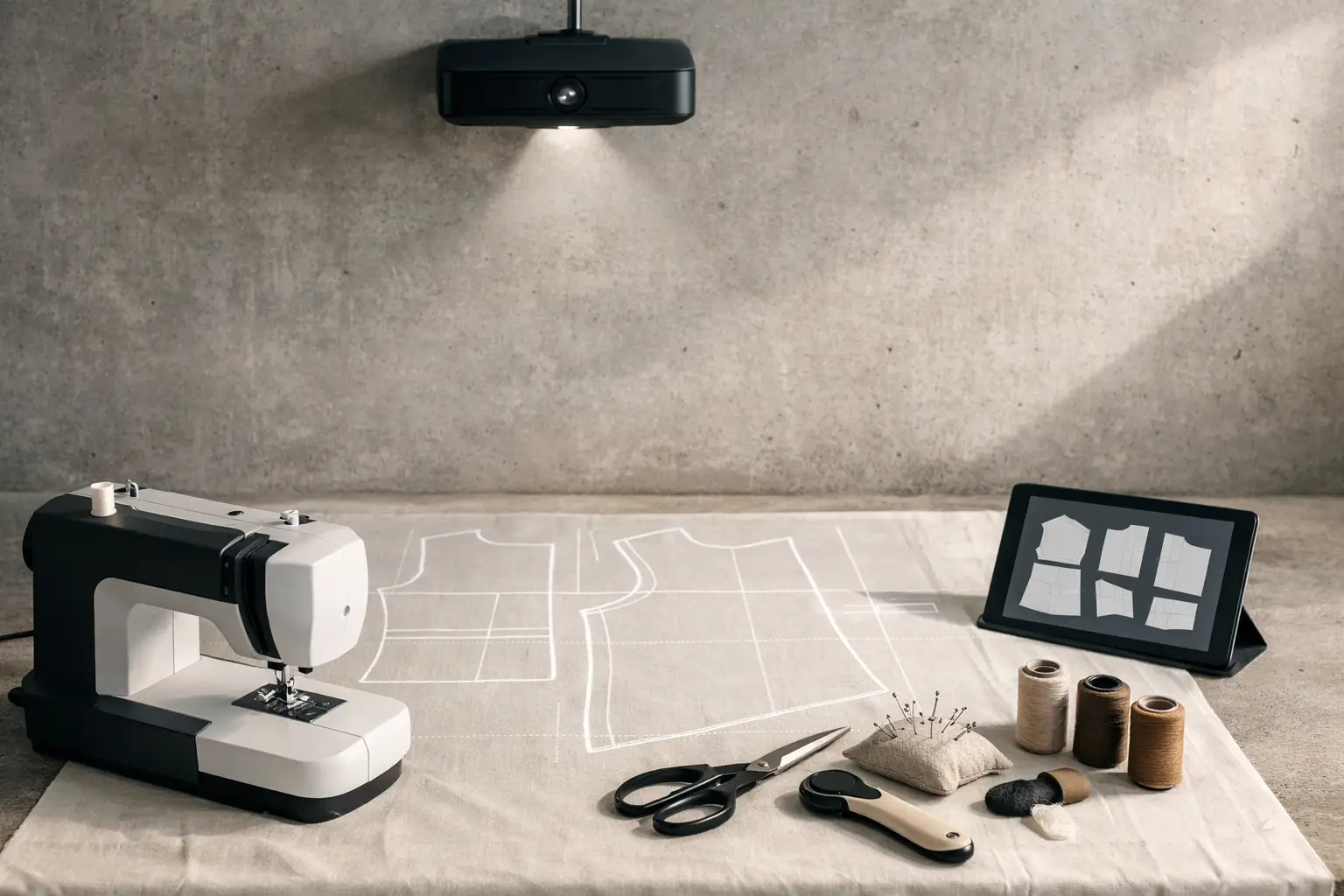
If you’ve ever spent an hour printing, trimming, taping and assembling a PDF pattern before sewing a single stitch, you’re not alone. It’s one of the biggest frustrations beginners experience.
That’s exactly why projector sewing patterns for beginners have become so popular over the last few years.
Instead of printing dozens of pages, a projector displays your sewing pattern directly onto the fabric. You simply select your size, align the fabric, and start cutting.
For many sewists, projector sewing doesn’t just save paper—it completely changes the sewing experience.
If you’re already using beginner-friendly digital patterns like the Dadi Design Projector Sewing Patterns Collection, projector sewing can make every project significantly faster and more enjoyable.
What Are Projector Sewing Patterns?
Projector sewing patterns are specially prepared PDF files designed to be projected directly onto fabric at full scale.
Rather than printing A4, Letter or A0 files, you simply:
- open the projector PDF
- calibrate the image
- select your size layer
- place your fabric underneath
- cut directly from the projection
The pattern itself stays digital.
There is no paper to store, no taping pages together and no tracing unless you want to make personal adjustments.
Most modern projector files also include:
- layer options
- calibration grid
- high-contrast cutting lines
- dark mode
- large labels
- projector-friendly fonts
These small details make a huge difference when you’re cutting fabric.
Why Projector Sewing Patterns Are Perfect for Beginners
Many beginners think projector sewing is only for advanced sewists.
In reality, it’s often the opposite.
One of the biggest hurdles in sewing isn’t sewing at all.
It’s preparing the pattern.
Printing…
Checking scale…
Trimming…
Taping…
Finding mistakes…
Then discovering page 17 printed at 98%.
Projector sewing removes almost all of that.
Instead of spending an hour preparing paper, you’re preparing fabric.
That makes starting a project much less intimidating.
If you’re still choosing your first digital pattern, you may also enjoy our guide:
→ How to Choose a Beginner Sewing Patterns PDF
because understanding digital pattern formats makes projector sewing much easier.
What Equipment Do You Need?
A projector setup sounds technical, but it’s surprisingly simple.
Most beginners only need:
- projector
- laptop, tablet or phone
- flat cutting surface
- rotary cutter or fabric scissors
- pattern weights
- washable fabric marker
- ruler
A short-throw projector is popular because it projects a large image from a short distance.
However, many sewists successfully use standard projectors mounted above a table.
The important part isn’t buying expensive equipment.
It’s creating a setup that stays consistent every time you cut.
How to Calibrate a Projector Pattern
Calibration sounds complicated.
It isn’t.
Every quality projector sewing pattern includes a calibration square.
Simply:
- Open the projector file.
- Project it onto your cutting surface.
- Measure the square.
- Adjust zoom until the measurement is exact.
That’s it.
Never skip this step.
Even moving the projector slightly can change the scale.
Professional pattern designers always recommend checking calibration before every cutting session.
It only takes a minute and protects both your fabric and your finished garment.
Choosing Your First Projector Sewing Pattern
Not every sewing project makes a great first projector project.
If you’re new, choose patterns with:
- relaxed fit
- simple construction
- few pattern pieces
- stable woven fabrics
Excellent beginner choices include:
- oversized tops
- boxy shirts
- tote bags
- crossbody bags
- elastic waist pants
- simple dresses
Avoid highly tailored jackets or fitted blouses until you’re comfortable with the workflow.
If you’re unsure where to begin, our guide to Best Sewing Patterns for Boxy Tops explains why relaxed silhouettes are one of the easiest garments for beginners.
Why Oversized Garments Work Especially Well
Projector sewing pairs beautifully with oversized clothing.
There are fewer fitting issues.
Cutting is faster.
Small inaccuracies are usually invisible.
That’s exactly why oversized garments are often recommended as first sewing projects.
Fabric selection also becomes much more forgiving.
If you’re choosing fabric for your first projector project, read:
→ What Fabric Suits Oversized Garments Best?
Choosing the right fabric will often have a bigger impact than the pattern itself.
The Biggest Mistakes Beginners Make
Skipping calibration
Always measure the test square.
Even experienced projector users check it every time.
Using dark fabric in bright rooms
Projector lines become difficult to see.
Dim the lights or increase projector brightness.
Ignoring layers
One of the greatest advantages of projector patterns is layer selection.
Showing only one size dramatically reduces visual clutter.
Choosing difficult fabrics first
Slippery rayon, satin and lightweight silk can move while cutting.
For your first projector project choose:
- cotton poplin
- linen blends
- cotton twill
- chambray
Stable fabrics make the entire process easier.
Why Quality Projector Files Matter
Not every PDF pattern works well with a projector.
Professional projector files are designed differently from printable files.
Look for patterns that include:
- projector layers
- dark mode
- large readable labels
- calibration grids
- bold cutting lines
- accurate scaling
- multiple file formats (A4, Letter, A0 and Projector)
At DADI Design every sewing pattern includes multiple formats, allowing you to switch between home printing, copy shop printing and projector sewing whenever you like.
That flexibility becomes especially valuable as your sewing skills grow.
Projector Sewing Helps You Sew More
One surprising benefit of projector sewing is psychological.
Starting becomes easier.
When preparation takes five minutes instead of forty-five, you’re more likely to actually begin a project.
That means:
- more finished garments
- faster skill development
- less sewing fatigue
- more confidence
Many sewists discover that they repeat favourite patterns far more often because opening a projector file is so much easier than rebuilding paper patterns every time.
Frequently Asked Questions
Are projector sewing patterns good for complete beginners?
Yes.
Once the projector is calibrated, many beginners find projector sewing easier than assembling printed PDF patterns.
The cutting process is faster, cleaner and far less intimidating.
Do I need a special sewing machine?
No.
Projector sewing only changes how you cut fabric.
You can use any sewing machine that works for your chosen project.
Can I still print the pattern later?
Absolutely.
The best digital patterns include multiple formats including A4, US Letter, A0 and Projector files, allowing you to switch methods whenever you prefer.
Are projector patterns accurate?
Yes—provided the calibration square measures correctly before cutting.
Professional projector files are drafted at exactly the same scale as printed patterns.
Final Thoughts
If you’re looking for the easiest way to start sewing, projector sewing patterns for beginners are one of the biggest improvements modern digital sewing has introduced.
They remove the repetitive preparation that often discourages new sewists and let you focus on what really matters—making something you’ll actually wear.
Start with a relaxed pattern, choose a stable woven fabric, and keep your first project simple.
If you’re completely new to sewing, these guides will help you build confidence step by step:
- How to Sew for Beginners Without Stress
- Best Beginner Sewing Patterns Clothes
- 12 Beginner Sewing Projects for Adults
- Why Modern PDF Sewing Patterns Work
And when you’re ready to skip printing altogether, explore the Dadi Design Projector Sewing Patterns Collection, where every pattern is available in Projector, A4, Letter and A0 formats, making it easy to sew however you prefer.
Leave a Reply
You must be logged in to post a comment.